Stop Touching Everything!

As an adult I learned of a “personality test” that helped me figure out what my “Love Language” is. Most of you who know me (or know someone who knows me) knows what I’m talking about. But if you don’t, read on.

There are 5 love languages: Receiving Gifts, Acts of Service, Words of Affirmation, Quality Time, and Physical Touch. Whichever of these languages you speak, you probably are very good at living them. Typically, if your love language is Receiving Gifts, you give them as well as you receive them. If Words of Affirmation make you feel loved, you probably affirm the people in your life. You get the idea.

There is also the possibility that you have been deeply scarred by the wrong use/negative end of the language. If you speak Quality Time then the lack of it as a child can be detrimental to your feelings of self worth. If you cherish Acts of Service but had to fend for yourself as a child, then you are probably living the polar opposite of your language.

My Love Language is Physical Touch. In my early childhood I experienced the very negative end of my love language. When I was adopted at the age of 6, I had to learn to adapt to healthy forms of touch. I think I was very resistant to ANY touch though, because I don’t remember much of it, although it may have been there. My memory is very faulty. If I had to explain it, I’d say that if the situation wasn’t hugely life altering, I didn’t focus on the event. So much of my life, to this day, is wiped clean in my memories because it wasn’t earth shattering. I remember the important stuff, like the birth of my children. But when we went to the bay and swam that one time and it was so great, you know? No. I don’t remember. So, basically, my life is great! How can I be bogged down by that one time that kid was mean to me, if I don’t remember it? And I have recovered so much from the early trauma, thanks to Mom who was my counselor, that I operate in my love language in a healthy way.

Still, there are some memories that hang in there. Like Dad tossing me in the air, or Mama giving me a squeeze. But I think, because they are associated with touch, that is why they stick. Including the memory (well, memories) of my mom saying things like “Do you have to touch every one”, “Quit touching those”, and “Stop touching everything.” (Sorry Mom 😉). I have to say, that even as an adult, I still catch myself running my hand along a clothes rack or just touching that breakable thing that I’m afraid to pick up. I loved my kids when they were little (and babysitting now) because I love hugs and snuggles and face patting.

So when I took this test (which you can find here http://www.5lovelanguages.com/) I was not surprised by the outcome. There were other categories that definitely made sense to me, but I knew physical touch would be the main one. It’s not that you can’t operate in more than one area. In fact the better rounded you are the closer the gaps between categories. But, even now, if you think about it there is probably one strikingly obvious answer. My question, though, is this: if you have an obvious answer, whether because you took the test or because one of those categories stands out to you, do you have childhood memories that reinforced your love language? Like my need to touch, then and today, do you have similar experiences? Whether it is receiving gifts, words of affirmation, quality time, acts of service, or physical touch, do you have moments that stand out like that?

To take it a step further, do you know your spouse’s love language? Your child’s? What have you done today to speak their language? Have they spoken yours? Language, you know, is a two way street. One needs to speak so another can understand and vice versa.

Let’s go one step farther. Your closest circle of friends. Do you know their language? Have you tried to learn? What makes them tick? I confess, I am no giant in this area. I have a lot to learn about my friends and loved ones. Hopefully, you are farther along than I am. But I’m getting there. And that’s how we’ll build community.
Self-inflicted suffering

“You will continue to suffer if you have an emotional reaction to everything that is said to you. True power is sitting back and observing everything with logic; true power is restraint. If words control you that means everyone else can control you; breathe and allow things to pass.” -Unknown

In today’s world it seems that most people are ready to be offended at the slightest thing. It’s one thing for a child to take to heart the hurtful words thrown his way, and quite another for an adult to get offended because someone else’s view doesn’t match their own.

My previous post talks about hurtful words. This post is about taking away that power. Words can only hurt you if you let them. At some point in your life, and hopefully before you become an adult, you have to realize that words are just words. And even if they hurt, you can control the power they have over you by controlling your own reaction. The only power anyone and any word can have over you is the power you give it.

I know a man who says to himself everyday “I am my own sunshine.” Don’t get me wrong, he loves God. He lives for God. But telling himself this phrase is his way of reminding himself that he does not have to let the shadows of negativity in. He can remain the calmest person in the face of the biggest meltdown. And he has seen some doozies! Regardless of the emotional whirlwind in front of him, he can stand still and let the storm pass. And he doesn’t take it personally. He’s the better for it, too.

Learning this lesson is tough. Especially in today’s world where everyone has the right to be offended and to say anything they want because, hey, free speech. Matthew 24:10 says “And then shall many be offended, and shall betray one another, and shall hate one another.” In the prophetic words of Jesus, we see American society today. The constant haranguing of anyone with a differing opinion, the excessive need to be right, and the constant trampling of other’s rights in order to be the right one, are all leaving an indelible impression on the next generation. Why should your child learn to “let it go” when you clearly can’t? What, exactly, do we think we are teaching our children? Yes, words hurt. But you can choose to say “that person doesn’t know what they are talking about” or “that does not apply to me, no matter what they say”. Will we teach our children to open a dialogue instead of a name-calling session? Will we teach our children, by our own actions, to put aside those words and focus on their own actions and to take responsibility for them? Teach your daughter, that little Suzy saying she’s ugly, is not only untrue, but shows just how little Suzy thinks of herself.

And teach your son that just because little Justin said he’s dumb, doesn’t make it so . . . and that punching Justin for saying it is just as wrong as Justin saying it. I believe this is why we have so many adults who throw temper tantrums over words. Come on, y’all. They’re just words. You have full control of your own actions and emotions. Take charge. And stop letting the other person control you.

What lesson are you teaching your child? How can you improve your response to hurtful words? Do have conversations about this very thing with your children? In the family, don’t just be the example. Be an example AND an instructor.

My thoughts on raising children

My niece, recently found out she’s having a boy and asked me if I had any advice in the raising of boys. This is what I told her:

1. Be consistent. If you said “no you can’t have candy right before dinner”, that needs to be the rule ALWAYS. “Let your yes be yes and your no be no” is good in this instance, although for proper context, maybe it should be “a double-minded man is unstable in all his ways.” Kids will test you 25 million times to see if your answer will always be no or yes. It needs to be. That’s how you build their trust.
2. Pick your battles. Some things aren’t worth fighting over. Let’s say that his newest thing is a contest of wills. If you tell him to go sit in the time out chair and he sits right where he is, well, that works too. He is sitting, which is the goal. Just because it’s not in the exact spot you said doesn’t mean the action didn’t happen. Ephesians 6:4
3. Be firm. You can’t worry about hurting his feelings. No one LIKES to be in trouble (Hebrews 12:11). But that’s how we learn. And don’t get drawn into an argument. YOU are the grown up, he’s a child. But, by the same token, don’t be mean. Ecclesiastes 5:6
4. If you are going to spank, use a spoon or paddle. Never your hand. You want him to be afraid of the spoon, not you. Also, discipline should NEVER be done in anger. Calm yourself down before disciplining. (Www.thegospelcoalition.org/…/seven-principles-for-angry-pa…/)
5. Love, LOVE, love! Believe it or not, there will be days you won’t like him. But you love him anyway, just like God loves you.
6. Food is not a reward or a punishment. It’s survival. Nothing more, nothing less. Don’t fall into “I’ll give you a cookie if . . .” Or “clean your plate or else . . .” There are so many other things that hold a higher importance in life. (Philippians 1:10) Don’t get me going on the psychological damage that can be caused by rewarding or withholding food.
7. Demand obedience when he’s young and it’ll be easier for him when he’s older. Ephesians 6:1-3
8. Give him chores. Appropriate ones at appropriate ages. You can find lists on Google. Chores will keep him realistic. Ecclesiastes 3:22
9. Create in him an attitude of gratitude. It makes a happier kid. And start that early. Like, as soon as he can talk. Every night before bed, when you say prayers with him, list three things you are thankful for. Encourage him to think of some as he grows. A house, food, lights . . . these are all blessings. Too many people go without any of them. And then we in America have soooooooooo much more. 1 Thessalonians 5:16-18, Hebrews 12:28. (Also:www.verticallivingministries.com/…/10-benefits-of-giving-t…/)
10. Dedicate him to God. Give him back, in a way, to the One who gave Him to you. It is not a baptism. It is merely a symbol of offering your child to God in the hopes that they will in turn trust in God and be trained by Him. 1 Samuel 1:11.

That’s my two cents. What is yours?

Beautiful You 

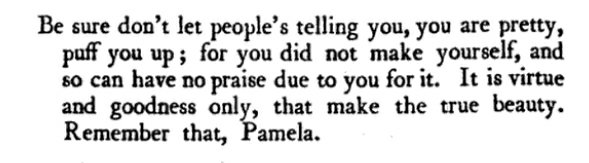
The above is an excerpt from Sir Edward Richardson’s Pamela, or Virtue Rewarded. They come from a father admonishing his daughter against pride in/becoming puffed up over her beauty, a thing she had no hand in.

When I read this bit, I was taken back to a poem I wrote in high school. I called it Beautiful to You. In it, I cried out to God, asking him to make me beautiful in His eyes. To do a work on the inside, hoping it would make me more attractive on the outside. You see, I thought I was ugly. Not just ugly, but the ugliest thing imaginable. And there were so many who just reaffirmed that. I didn’t realize how false that was until I hit adulthood.

I fell in love for the first time at 19. What a change flattery can make! Then I learned that the only interest that first love ever had in me was based entirely on my looks and how they might help him. That was just as devastating as growing up believing I was ugly. And I saw, quickly, that I could “have no praise due to me for it”.

In high school, I cried out to God for beauty. As a young adult I alternately gave Him thanks for my looks and was angry for my looks. In the end I just wanted Him to see me as beautiful, and forget the people. I yearned to hear from the One who made me. All those others who had convinced me that I was ugly, wounded me. But I would find my solace in God. And so I developed a relationship with the One who made me.

I’m sure that many of those who called me names, who went out of their way to be mean, to hurt, to laugh at me never believed that they were just expanding an already big problem for me. I know for a fact that some of them believed I thought too much of myself (I did say before that I worked very hard NOT to be so shy and introverted, that gets confused with stuck-up a lot). But the damage was done regardless.

If I could instruct every single child on the planet in one thing, it would be this: watch your words. Words DO hurt. Words can cause irreparable damage. If I had not turned to God, I think depression would have taken hold of me to such a degree that I would not have been able to escape it. And while children are mean enough to their peers, adults do just as much damage with a careless word or thoughtless tease. It seems crazy to me the number of adults in my own life who hurt me with their words. (On a side note, there is another post coming concerning the notion that, come on, they are just words.)

Let every person tell every child: You are beautiful. You are precious. You are worthy. You are loved. These should be standard phrases in the house of a child. Sadly, that is not true. If you spend any time with a child, tell them these things. But also, tell yourself these things. You need to hear it, too. Whether you are 5, 15, or 95, YOU need to hear it! You are beautiful! I thank God for a mother who encouraged me to think for myself, who gave me support, and had I confessed these feelings to her as a child, I have no doubt she would have fought like a mama bear protecting her young to keep anyone from saying anything amiss. (Unfortunately, this is probably her first time knowing it.) But I came to grips with my feelings of inadequacy, where my looks were concerned, years ago. I now hold no illusions about myself. I look like me. I look like God created me to look. It is neither beauty nor beastly. It is the me He made. And I am good with that.

If you are not good with who you are, are not happy with the Creator’s design of you, take it up with Him. He won’t change how you look, but He will change how you feel about it. In the meantime, have a listen . . .